Stablecoins: The Future of Payments
4th Mar 2026

Table of Contents
Introduction
What is a Stablecoin, what are they used for and sample Stablecoins
Similarities and Differences of Cryptocurrencies and Fiat Currency with Stablecoins
Comparison of making payments via stablecoins vs. traditional fiat
Benefits and risks of using stablecoins in payments
Conclusion
1. Introduction
With our fast paced economy nowadays, there’s a need to keep up with the current business demands in real time and using traditional fiat payment methods to comply with these business needs may cause delays due to settlement, cut-off and currency conversion issues. This is where the significance of using stablecoins comes into play - from receiving payments from customers to paying suppliers for their goods and services, stablecoins offer a more flexible, efficient and much faster mode of making and receiving payments. Even though stablecoins are designed to maintain price stability, every transaction still needs to be recorded properly through reliable crypto bookkeeping systems.
2. What is a Stablecoin, what are they used for and sample Stablecoins
A stablecoin is a type of cryptocurrency designed to maintain a stable value, typically by being pegged to a fiat currency or commodity, though stability depends on reserve structure, governance, and market confidence. Since stablecoins belong to a category of digital assets recorded on blockchain networks, they also require proper accounting and crypto tax reporting.
Stablecoins function as digital representations of value on a blockchain, but unlike bank deposits, they are not government-insured and depend on the issuer’s reserve and redemption framework. They are commonly used to:
- Send and receive payments, in lieu of traditional fiat currency
- Cash Management - holding digital money to prevent exposure from market volatility
- Crypto tradings and settlement
Examples of commonly used stablecoins include Tether (USDT) which is the most popular and largest stablecoin by market capitalization and USD Coin (USDC), which are both pegged to US Dollar and DAI which is a crypto-backed stablecoin governed by the MakerDAO community.
3. Similarities and Differences of Cryptocurrencies and Fiat Currency with Stablecoins
Like stablecoins, cryptocurrencies operate on blockchain technology, can be used to send and receive payment and hold and move funds, in a fast and convenient way. However, unlike stablecoins, cryptocurrencies are highly volatile, making them generally less practical for routine business payments.
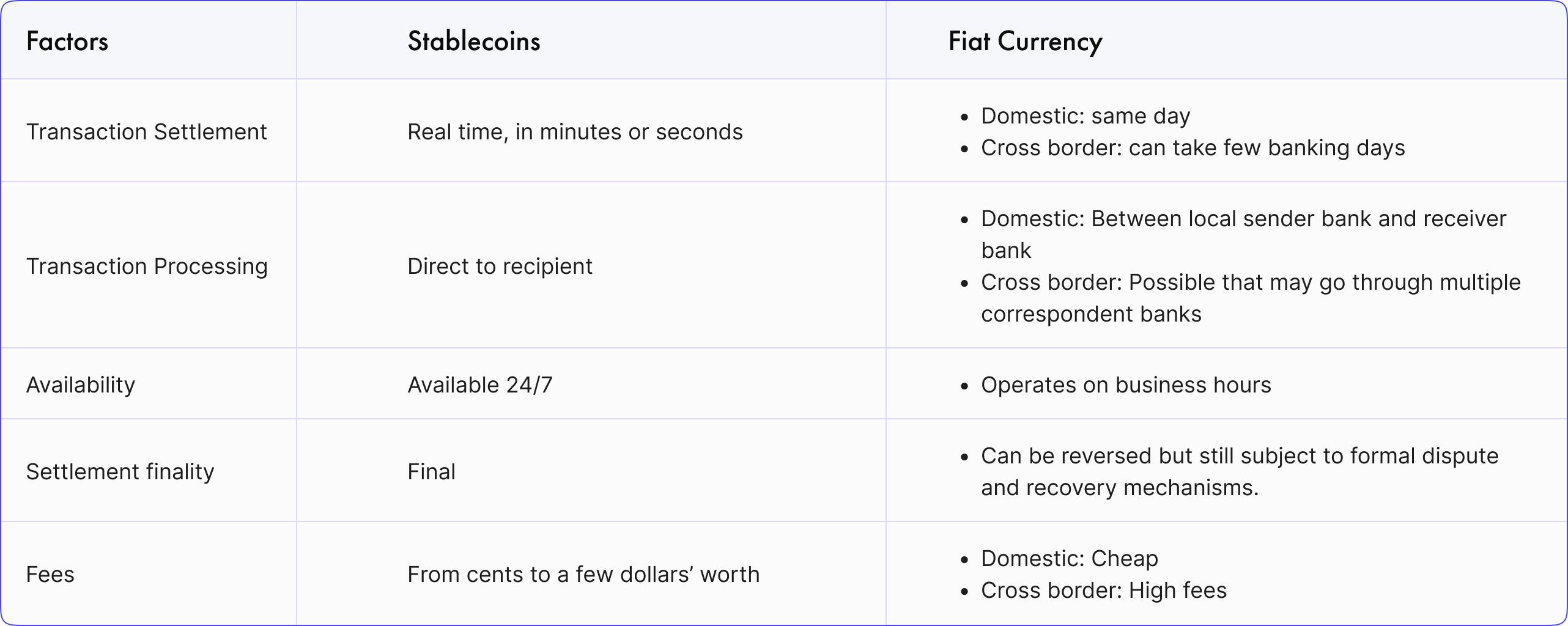
On the other hand, fiat currency, like stablecoins, are both stable in value, making it suitable to use for regular business transactions. In contrast to stablecoins, fiat currency in terms of processing payments and moving money, rely on banking institutions which may cause delays as banks impose cut-off time and in case of cross-border transactions, may be processed by intermediary banks before being received by the recipient.
4. Comparison of making payments via stablecoins vs. traditional fiat
5. Benefits and risks of using stablecoins in payments
Benefits:
- Price stability: Stablecoins are pegged to a stable currency or commodity.
- Speed: Sent stablecoins are received real time.
- Availability: Available anytime (24/7/365) and anywhere.
- Both parties (sender and receiver) only need to have a digital wallet to send and receive stablecoin, without the need for a bank account.
Risks:
- Currency substitution: Stablecoins might be used much more often in making regular payments and savings instead of using the local fiat currency.
- As with fiat currency, stablecoins can be misused if deployed without proper compliance controls such as KYC/AML.
- Once the payment is sent to a wrong or unintended address, the possibility of retrieval is slim unless the receiver returns it.
- Businesses accepting crypto payments (including stablecoins) must track transactions correctly to avoid crypto tax issues and audit risk.
6. Conclusion
While using stablecoins has become one of the most compelling ways of doing payments in this fast-paced environment, we still need to weigh the benefits and risks of using it.